









How Many Websites Use WordPress in 2026? WordPress Market Share Explained

WordPress remains one of the most widely used website platforms in the world. But exactly how many websites use WordPress?
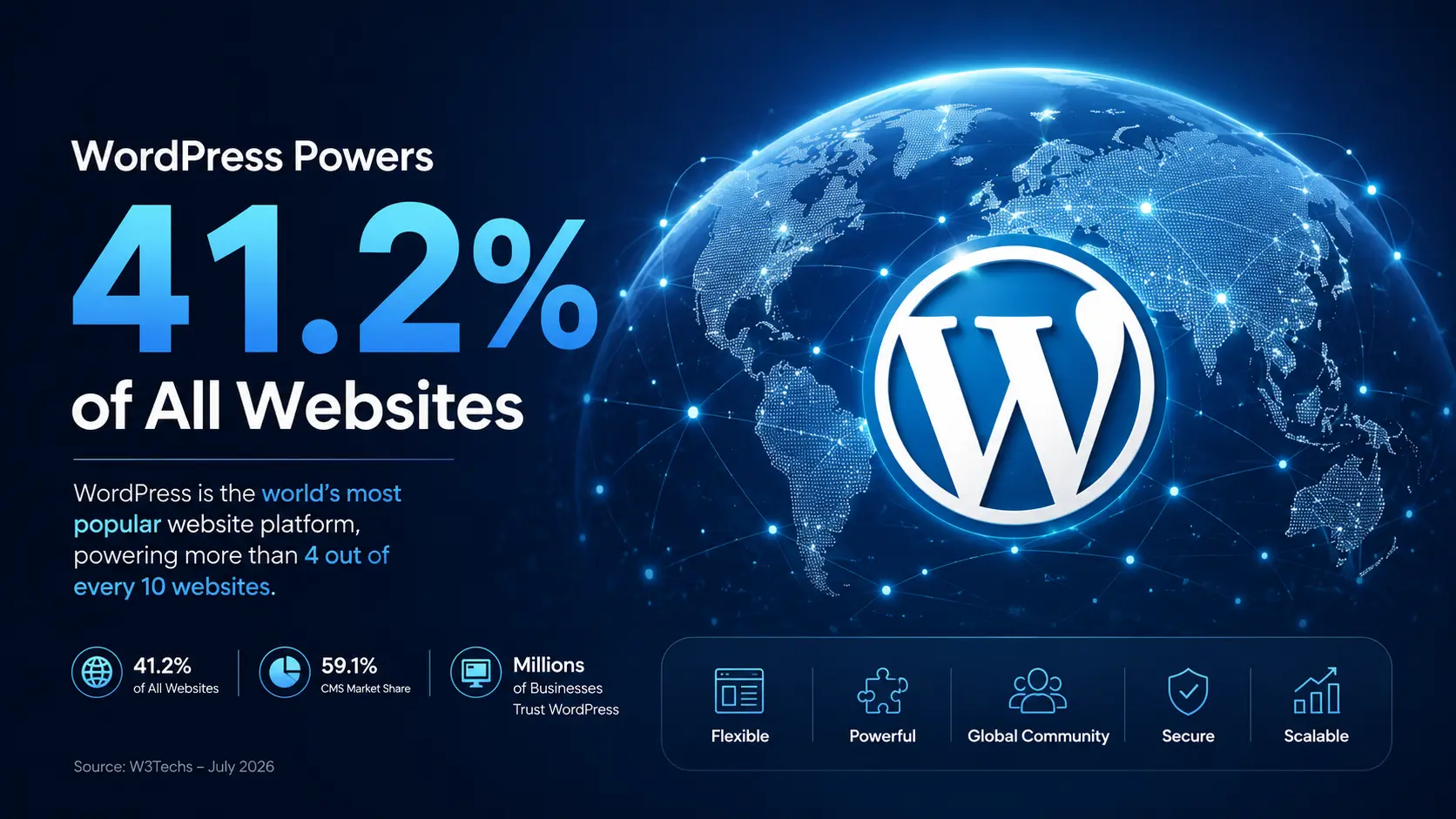
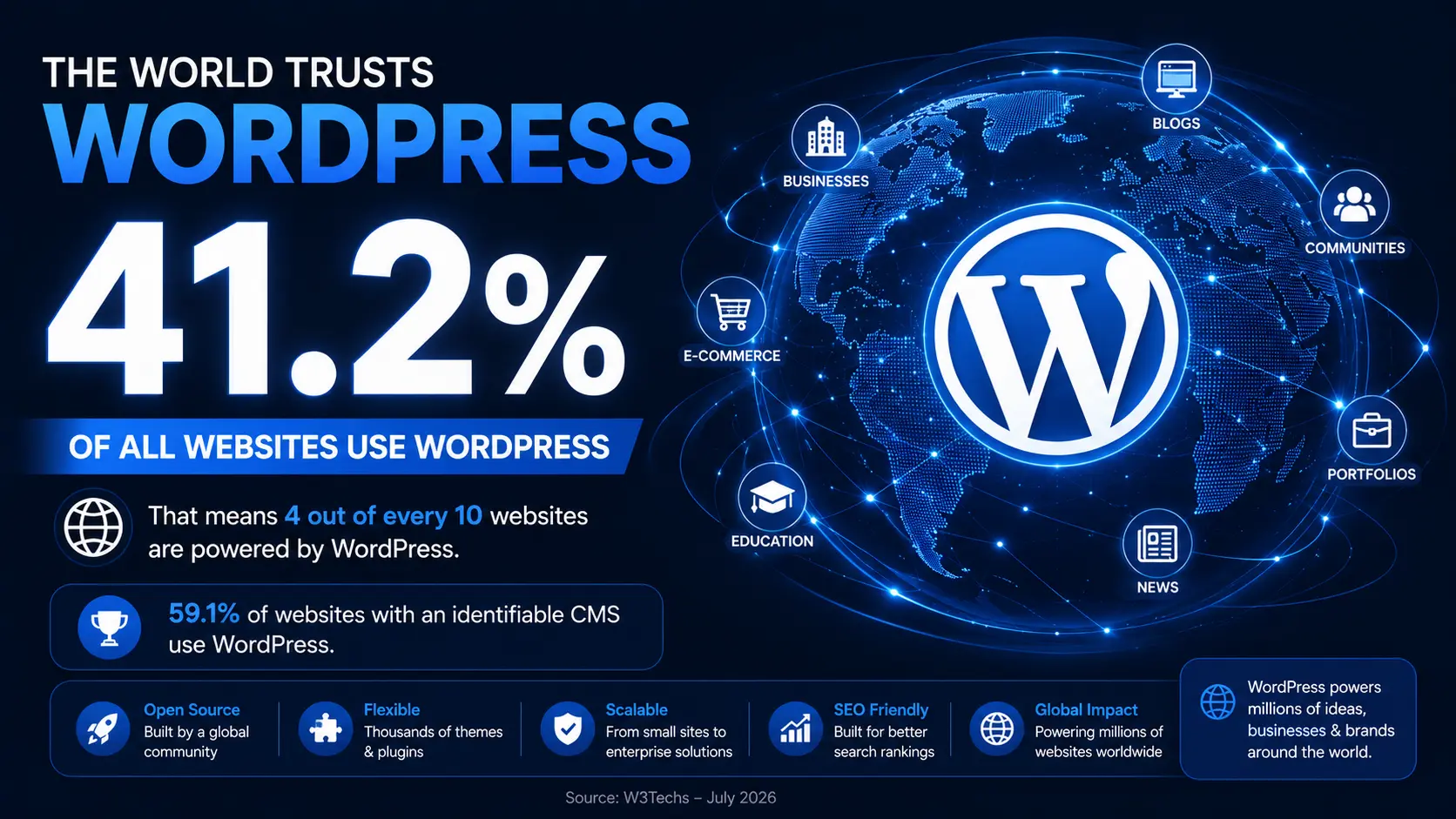
According to the latest July 2026 data from W3Techs, WordPress is used by 41.2% of all websites measured in its survey. That means approximately 4 in every 10 websites are built with or powered by WordPress.
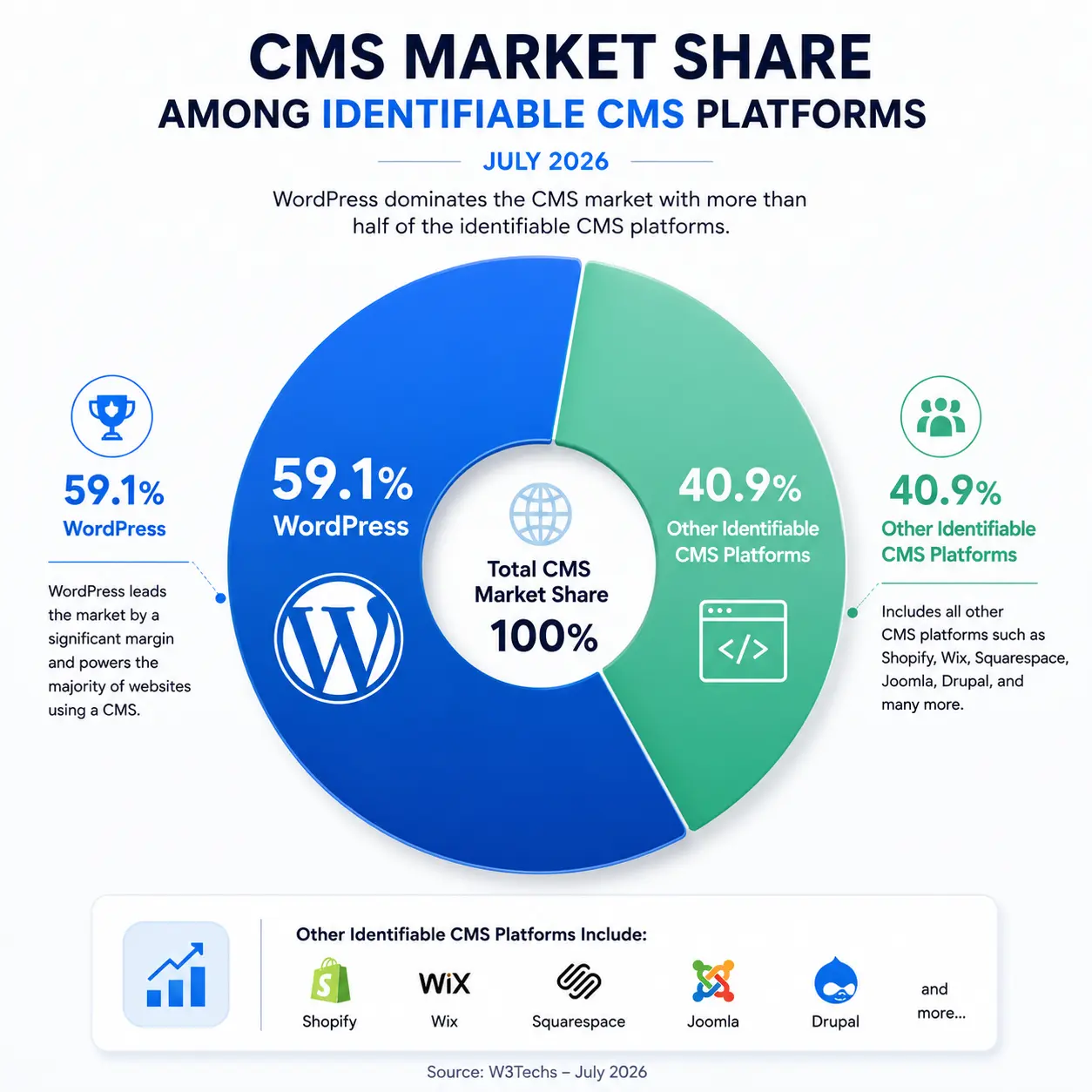
Among websites where the content management system (CMS) can be identified, WordPress has an even larger 59.1% CMS market share.
This distinction is important because not every website uses a recognizable content management system. Many websites are custom-built, use static-site technologies, or run on platforms that W3Techs does not classify as a traditional CMS.
WordPress Powers More Than 4 Out of 10 Websites
The easiest way to understand WordPress’s current position is to look at its share of the entire web.
In July 2026:
- 41.2% of all websites use WordPress.
- 59.1% of websites with an identifiable CMS use WordPress.
- 30.4% of websites use none of the CMS platforms monitored by W3Techs.
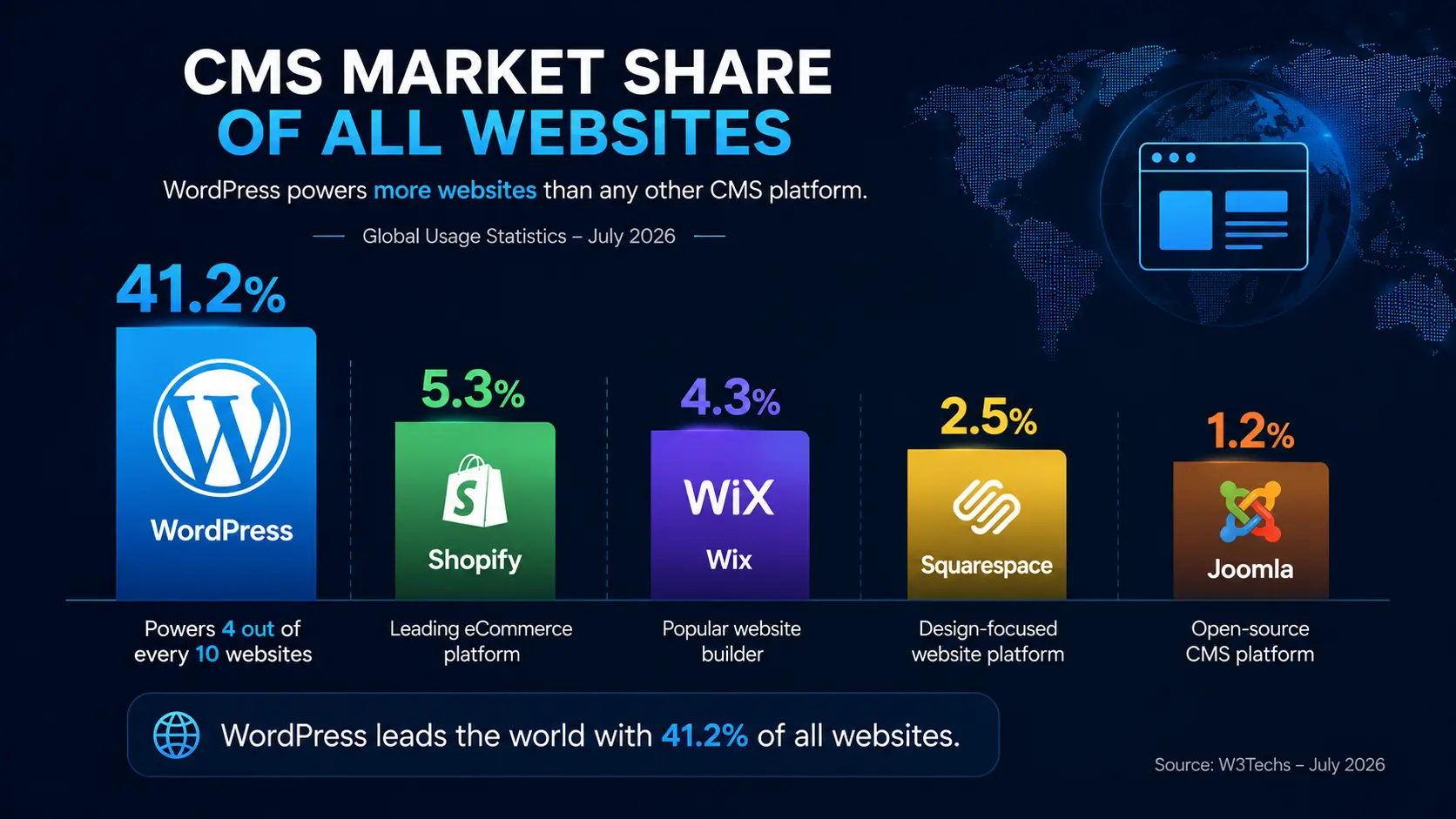
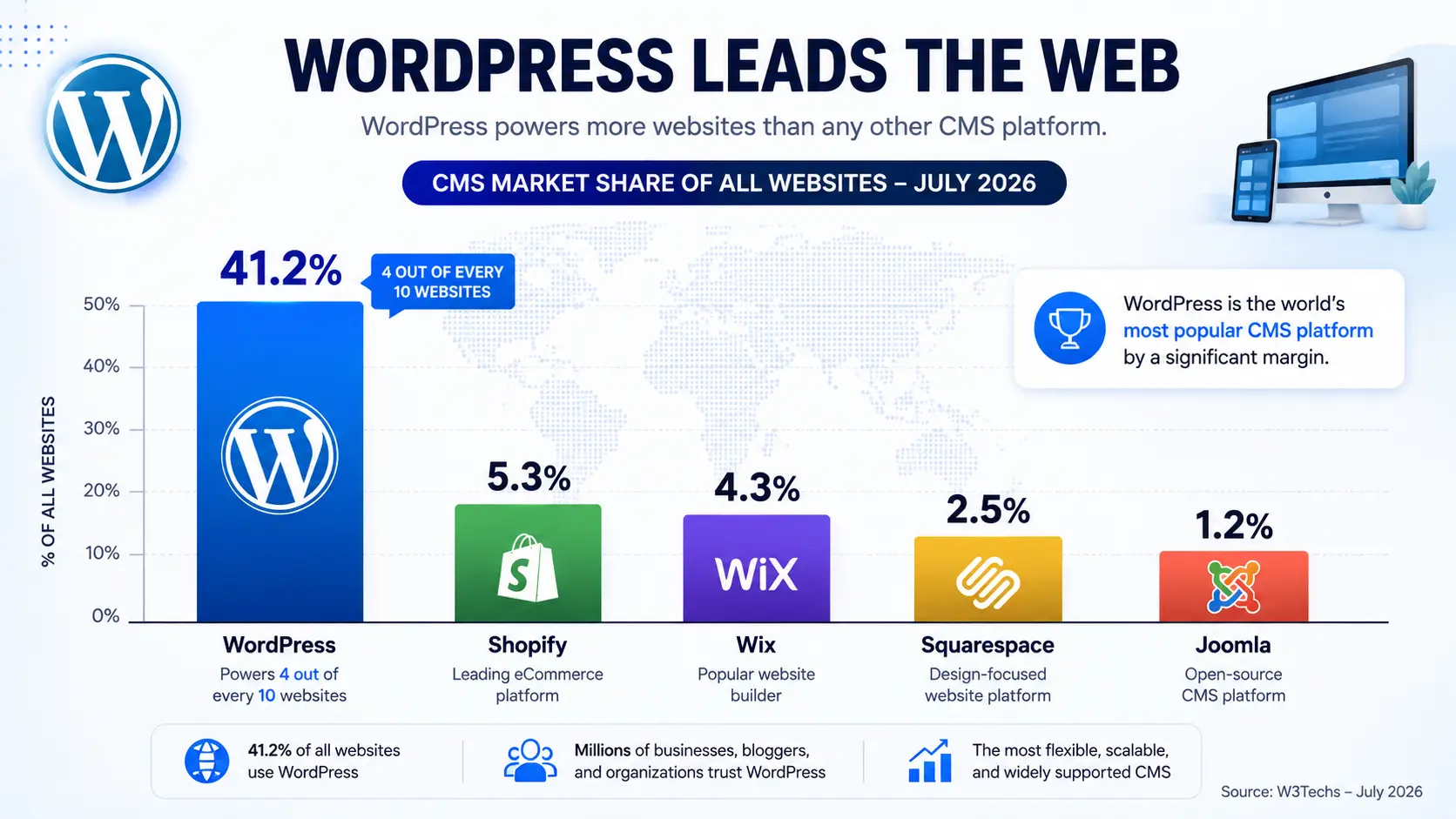
- Shopify follows WordPress with 5.3% of all websites and a 7.6% CMS market share.
- Wix accounts for 4.3% of all websites and a 6.1% CMS market share.
This makes WordPress substantially larger than any individual competing CMS platform.
What Does “41.2% of the Web” Actually Mean?
The phrase “41.2% of the web” can be misunderstood.
It does not mean that 41.2% of every domain registered in the world runs WordPress. There are billions of domains, and many are parked, inactive, private, redirected, or otherwise difficult to classify.
W3Techs measures websites for which it can identify technologies and uses its own methodology to estimate technology usage.
Therefore, the most accurate statement is:
WordPress is used by 41.2% of all websites measured by W3Techs as of July 2026.
Among websites where the CMS is identifiable, WordPress’s share rises to 59.1%.
This is the statistic businesses, agencies, developers, and marketers should use when discussing WordPress’s market position.
WordPress vs. Other CMS Platforms
WordPress is not simply the largest CMS; its lead over individual competitors is significant.
According to W3Techs’ July 2026 data:
| CMS | Share of All Websites | CMS Market Share |
|---|---|---|
| WordPress | 41.2% | 59.1% |
| Shopify | 5.3% | 7.6% |
| Wix | 4.3% | 6.1% |
| Squarespace | 2.5% | 3.5% |
| Joomla | 1.2% | 1.7% |
| Tilda | 0.8% | 1.2% |
| Webflow | 0.8% | 1.2% |
| Drupal | 0.7% | 1.0% |
The numbers demonstrate an important point: WordPress has a much larger installed base than any single competing CMS.
Why Is WordPress So Popular?
WordPress started primarily as a blogging platform, but it has evolved into a general-purpose publishing and website platform.
Today, WordPress can be used for:
- Business websites
- Corporate websites
- Blogs and publications
- News websites
- Portfolio websites
- Educational websites
- Membership platforms
- Online communities
- E-commerce stores
- Landing pages
- SaaS marketing websites
- Enterprise websites
- Government and nonprofit websites
WordPress.org describes the platform as being used for everything from simple websites and blogs to complex portals, enterprise websites, and applications.
Its ecosystem is also a major reason for its popularity. Thousands of themes and plugins allow businesses to add functionality without building every feature from scratch.
WordPress Has a Massive CMS Lead
One of the most important numbers is not the 41.2% figure but the 59.1% CMS market share.
Why?
Because the CMS market only represents websites for which a CMS can be identified.
W3Techs reports that approximately 30.4% of websites use none of the CMS systems it monitors.
If we remove those websites from the calculation, WordPress accounts for the majority of identifiable CMS-powered websites.
This means WordPress isn’t merely popular among website builders. It is the dominant traditional CMS platform by a substantial margin.
WordPress Is Also Strong Among High-Traffic Websites
WordPress’s popularity isn’t limited to small blogs and personal websites.
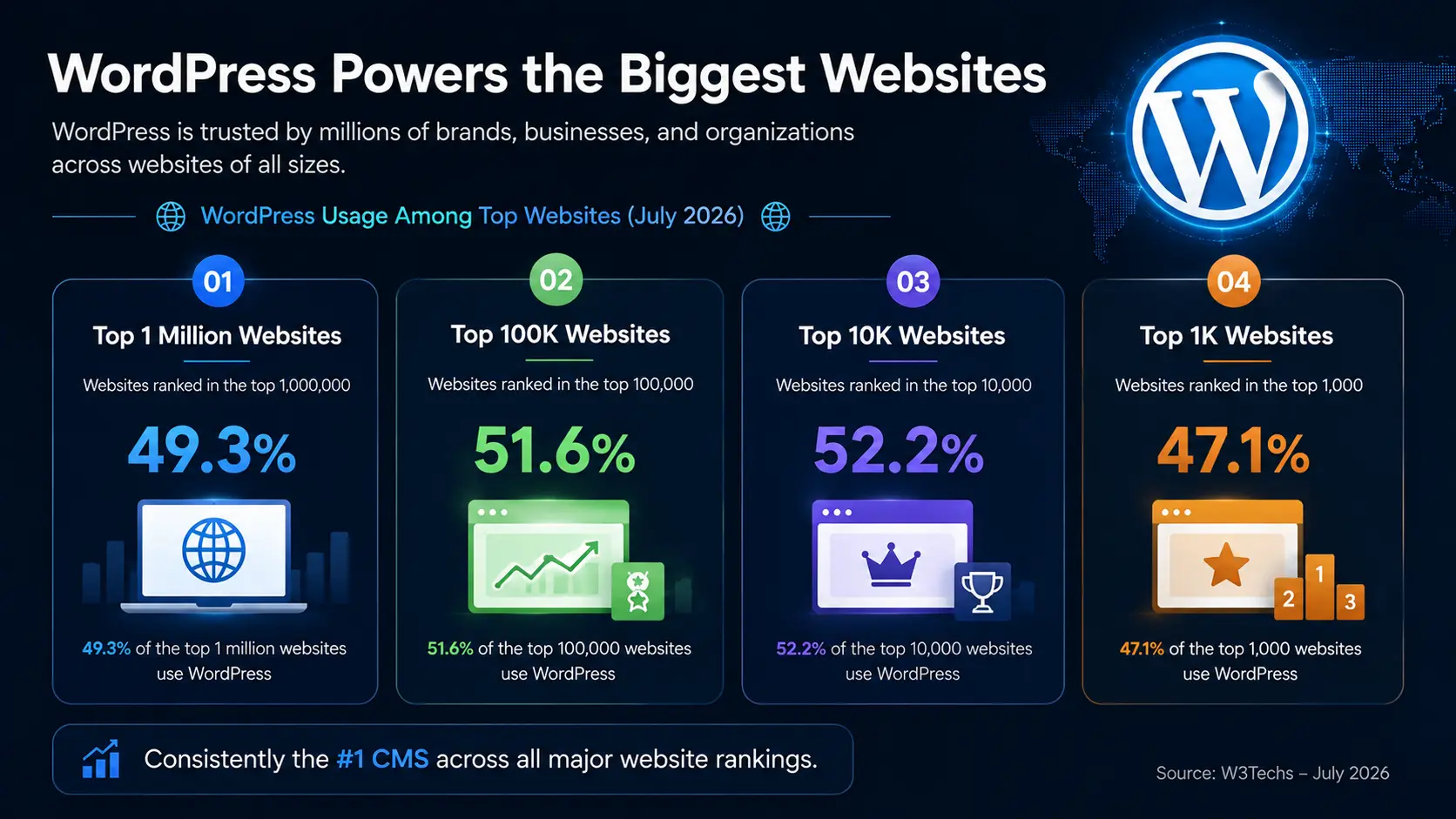
W3Techs’ July 2026 ranking data shows WordPress is used by approximately:
- 49.3% of the top 1 million websites
- 51.6% of the top 100,000 websites
- 52.2% of the top 10,000 websites
- 47.1% of the top 1,000 websites
These percentages refer to websites whose CMS is known within each ranking group.
This is significant because it demonstrates that WordPress is capable of supporting websites across different scales, from small businesses to high-traffic organizations.
Has WordPress Market Share Increased or Decreased?
WordPress’s market share has changed over time.
For example, W3Techs reported that WordPress accounted for 43.4% of all websites in July 2025, compared with 41.2% in July 2026.
That means the latest measured percentage is lower than a year earlier.
This is worth highlighting because saying that WordPress’s market share is simply “growing every year” would be misleading.
The web ecosystem is changing. New frameworks, hosted website builders, e-commerce platforms, static-site technologies, and custom development approaches continue to gain adoption.
However, WordPress remains by far the largest individual CMS.
WordPress vs. Shopify: Which Is More Popular?
Shopify is one of WordPress’s strongest competitors, particularly in e-commerce.
However, the two platforms serve somewhat different purposes.
WordPress is a general-purpose CMS that can be extended into e-commerce using solutions such as WooCommerce.
Shopify is primarily a hosted commerce platform designed around online stores.
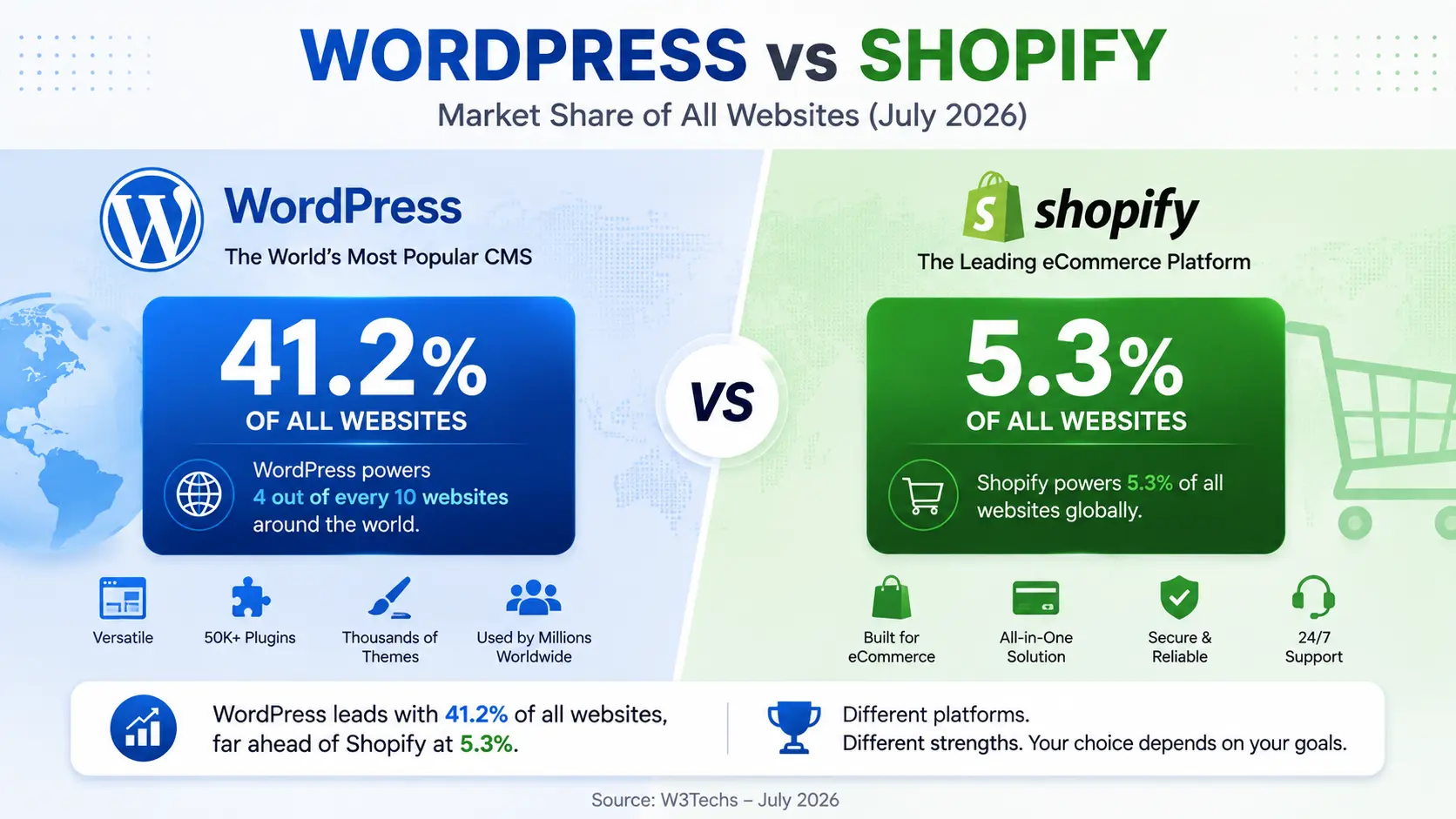
According to July 2026 W3Techs data, WordPress is used by 41.2% of all websites, while Shopify is used by 5.3%.
Therefore, in terms of total website usage, WordPress has a considerably larger footprint.
What Makes WordPress Different From Website Builders?
Platforms such as Wix and Squarespace provide hosted website-building experiences. WordPress offers a different model, particularly with self-hosted WordPress.
With self-hosted WordPress, website owners can control:
- Hosting
- Themes
- Plugins
- Website files
- Database
- Custom code
- SEO configuration
- Integrations
- Website performance
- Migration options
This flexibility has helped WordPress become popular with freelancers, agencies, developers, publishers, and businesses.
WordPress is also open source, meaning its software can be modified and extended. WordPress.org highlights its flexibility, theme system, plugin ecosystem, developer APIs, and ability to create everything from basic websites to applications.
Why WordPress Matters for Businesses
For businesses, WordPress’s enormous market share creates a large ecosystem of developers, designers, agencies, hosting providers, plugins, themes, and third-party integrations.
That ecosystem can reduce the difficulty of finding people who understand the platform.
It also means businesses can start with a relatively simple website and expand its functionality over time.
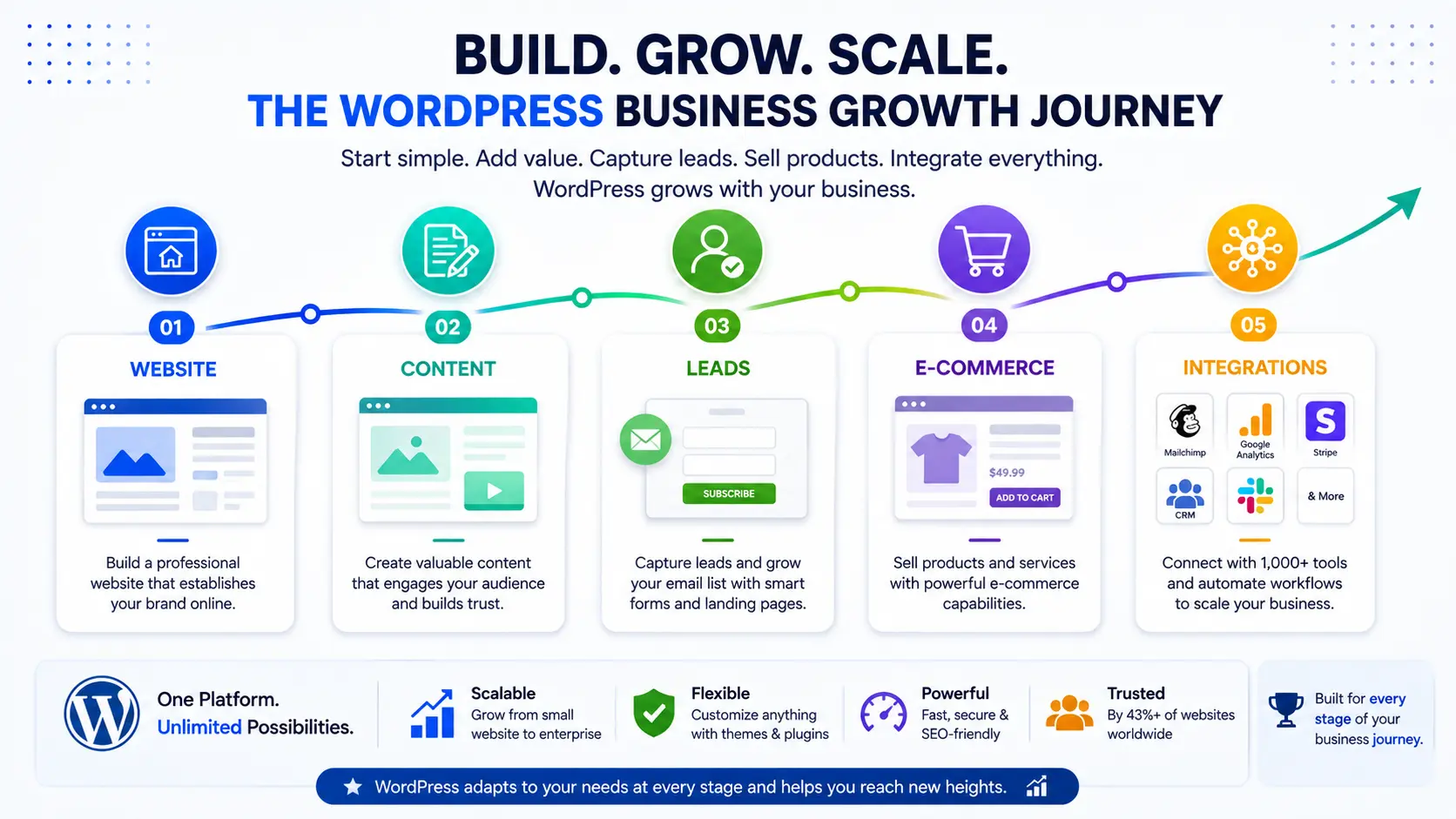
For example, a company might begin with:
Website → Blog → Lead Generation → E-commerce → Membership → Custom Integrations
without necessarily having to abandon the underlying platform.
This scalability is one reason WordPress continues to be used by organizations of very different sizes.
Is WordPress Still Relevant in 2026?
Yes-but the reason is not simply its market share.
WordPress remains relevant because it combines a large installed base with an extensive ecosystem and significant flexibility.
At the same time, businesses should not automatically choose WordPress for every project.
A custom web application, highly interactive SaaS product, or specialized enterprise system may be better served by a modern application framework or a headless architecture.
Similarly, a small business that wants an extremely simple hosted store may prefer Shopify.
The right platform depends on the project’s requirements.
But if the question is:
“Which CMS has the largest global footprint?”
the answer remains clearly WordPress.
The Bottom Line: How Many Websites Use WordPress?
Based on the latest July 2026 W3Techs data, 41.2% of all websites use WordPress.
That is roughly four out of every ten websites.
Among websites with an identifiable CMS, WordPress’s share is 59.1%.
So the most accurate way to describe WordPress’s global position is:
WordPress powers approximately 41.2% of all websites and holds about 59.1% of the identifiable CMS market.
WordPress.org itself states that WordPress powers more than 43% of the web, but the exact figure varies depending on the date and measurement methodology.
For an article published in 2026, using the 41.2% W3Techs figure with a date reference is the more defensible approach.
Frequently Asked Questions
What percentage of websites use WordPress in 2026?
According to W3Techs’ July 2026 data, WordPress is used by 41.2% of all websites.
What is WordPress’s CMS market share?
WordPress has a 59.1% market share among websites whose CMS can be identified.
Is WordPress the most popular CMS?
Yes. WordPress has a substantially larger share than other individual CMS platforms, including Shopify, Wix, Squarespace, Joomla, and Drupal.
Is WordPress losing market share?
The latest W3Techs figures show a lower overall website usage percentage in July 2026 than in July 2025. However, WordPress remains the dominant CMS by a wide margin.
Is WordPress still worth using in 2026?
For many websites, yes. WordPress remains particularly strong for content-driven websites, business websites, publishing, marketing sites, blogs, and websites requiring a large plugin and developer ecosystem.
What is the difference between WordPress usage and WordPress CMS market share?
Usage share measures WordPress against all websites. CMS market share measures WordPress against websites where a CMS can be identified. Therefore, the 41.2% and 59.1% figures are both correct, but they answer different questions.